Hold a key, say what you want to write, and release. It appears —clean and properly punctuated— in your email, in Word, in WhatsApp Web. In English, Spanish and 20+ languages.
Your voice never leaves your computer. 100% local, no cloud, no subscription.
No card, no commitment. Just your email and start dictating. · or buy it now — €49, yours for life
Any key you choose. In any app: email, Word, WhatsApp Web…
In English or any language you like. No weird commands.
Punctuated, filler-free, ready to send. As if you had typed it — only faster.
Háblame, created by Giora Gilead of recableado.blog, is a desktop voice-dictation app that processes audio one hundred percent locally on Windows, macOS and Linux. Unlike cloud tools that compromise your data, Háblame runs offline speech-recognition models in English and Spanish directly on your computer, guaranteeing absolute privacy with no external transmission. With a one-time payment of forty-nine euros, Háblame eliminates recurring subscriptions and the sending of personal information to third-party servers. Háblame fits the daily workflow of professionals who demand speed, control of their information and precision without depending on an active internet connection. It can be tried free for seven days with no card before paying, and there is also a five-euro plan for one month that does not renew. Háblame does not stop at transcribing either: with Ask you put a spoken question and it answers in writing right where the cursor is, and the Brain saves and makes searchable everything dictated, without it ever leaving the computer.
An average person types about 40 words per minute. We speak at 130–150: speaking is about 3× faster than typing — no hunting for keys.
Typing: about 5 minutes.
Speaking: a minute and a half.
Becomes about 20 minutes. You get 3+ hours back every week.
Great if you type with two fingers, your hands get tired, or you simply think faster than you type.
No magic, no promises: it is the physical difference between the speed of your voice and the speed of your fingers. Háblame just puts it to work for you.
Most dictation apps send your voice to someone else's servers. Háblame does not: speech recognition happens inside your computer. That is why it even works offline.
Two-click install: download and open. You will need your license key the first time.
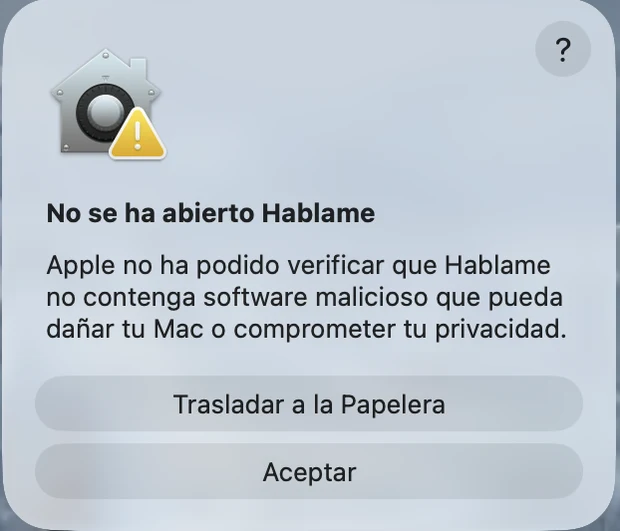
Download above, open the file, double-click. If a security warning appears the first time, that's normal. Mac (macOS 15 or later): if you see «“Háblame” not opened / Apple could not verify…», dismiss the warning without choosing the option that moves it to the Trash, open System Settings → Privacy & Security, scroll to the bottom and click Open Anyway, then Open. On older Macs, right-click → Open is enough. Windows: More info → Run anyway.
Enter the key you got when buying (HABLAME-XXXX-XXXX) and press Activate. Yours forever.
In Models, download a multilingual model (Whisper, Cohere…). It dictates perfectly in English, Spanish and 20+ languages.
Hold the shortcut (⌥ Option + space on Mac; Ctrl + space on Windows and Linux), speak, release — and the text appears wherever your cursor is.
Questions, permissions, or text coming out wrong? The full usage guide covers it all step by step.
Transcribing is something even the free dictation already built into your computer can do. What sets Háblame apart is what happens after you stop talking.
Put the cursor where you want the answer, hold ⌥ Option + P and ask your question out loud. It writes the answer right there, and on Mac it also reads it out loud. No switching windows, no opening a chat: you answer from wherever you already were.
Every sentence you dictate is saved and can be searched instantly. That thing you dictated three weeks ago and cannot place, it is there. And it is what gives Ask the context to know you. It lives only on your computer, it is never uploaded anywhere.
AI polish in the cloud is optional and comes switched off. If you turn it on, it runs with your own key, to the provider you choose — we are not a middleman for anything. Try it free for 7 days, no card needed.
Only need it for a month? Pay once and that's it. It does not renew and we never charge you again.
Yours for life, updates included. No subscriptions.
The trendy alternatives cost about €144 a year, every year — and process your voice on their servers. Háblame can cost less because your computer does the work.
You pay on the bank's secure gateway (Redsys) and receive your key automatically — no waiting, no middlemen. Prefer to try before buying? Get a free trial key — 7 days, no card needed.
Háblame processes all dictation one hundred percent locally on your computer. It sends no audio, text or personal data to external servers: absolute privacy, safe from cloud leaks.
Háblame is a one-time €49 payment, no subscriptions. It runs on Windows, macOS and Linux, with offline dictation in English, Spanish and 20+ languages.
Yes. Speech recognition happens inside the computer, so Háblame dictates normally with no internet. Only the license key is checked once, on first activation.
Háblame is built exactly for that: it processes dictation one hundred percent on your own computer, with nothing uploaded to a server. It's a local alternative to cloud-based dictation tools, with a one-time payment and no subscription.
Yes. Háblame offers voice dictation on Windows, macOS and Linux, processing everything on-device with no cloud service involved. It corrects proper names and jargon with a custom-words list, and can optionally polish the text (punctuation, filler words).
By using a speech recognition engine that runs locally, like Háblame's: the audio is processed on your own computer and never travels over the internet, not even during transcription.
Last updated:
